
According to the International Classification of Diseases 11th revision, or the ICD-11 (used by the World Health Organization, or WHO), CPTSD results from “multiple traumatic events.” Examples of this can include multiple incidents of child abuse (particularly repeated child physical abuse and repeated child sexual abuse); prolonged domestic violence; concentration camp experiences; torture; slavery; and genocide campaigns. CPTSD is in the ICD-11 but is not listed as a diagnosis in the DSM-5, which is what I believe most psychiatrists and psychologists use for diagnosing in the USA, where I’m located.
CPTSD includes symptoms of PTSD such as flashbacks or re-experiencing; avoidance; and sense of threat. However, CPTSD brings in more emotional and identity aspects as well, with the additional symptoms of affect dysregulation; negative self-concept; and interpersonal disturbances. These are referred to as disturbances in self-organization, or DSO.
The three DSO symptoms are:
- affective dysregulation: severe and persistent difficulties managing emotions;
- negative self-concept: low self-worth;
- and disturbances in relationships: difficulties in feeling close to people and in sustaining interpersonal relationships.
There is a significant overlap in the diagnoses of CPTSD and BPD, and admittedly some discussion as to whether they are separate diagnoses at all. The primary difference is that CPTSD can occur at any point in life, whereas BPD typically develops during adolescence. Here is a graph showing symptoms of CPTSD and BPD side-by-side in a sample of 280 female child abuse survivors:
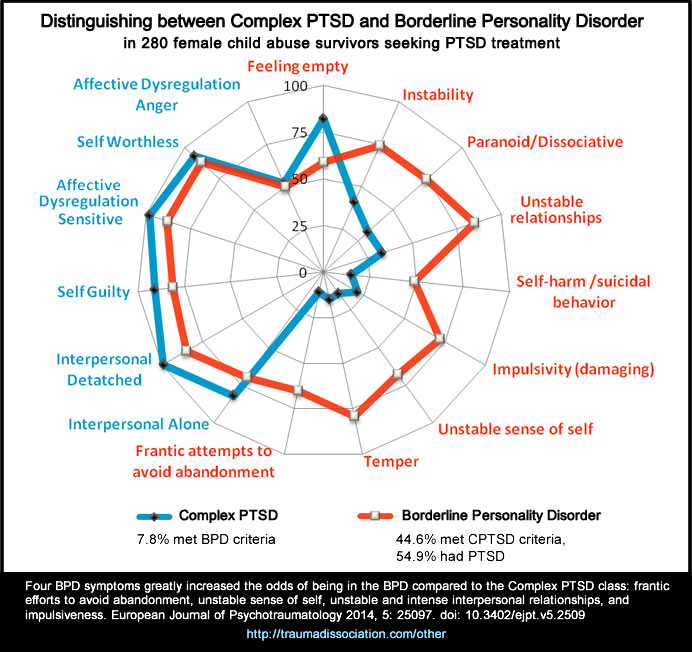
As we can see from this graph, a few key symptoms of BPD are missing from those who were said to have CPTSD: namely unstable relationships, self-harm/suicidal behavior, impulsivity, and identity disturbances. However, many who had BPD also met CPTSD criteria, and many others had PTSD. So the overlap is significant.
For more information on BPD, revisit my old posts about it, starting with: Episode 10 – The Borderline: A New Diagnosis (Part 1). I have also written Episode 14 – Borderline Tendencies (Part 1) and Episode 26 – BPD vs. Bipolar.
To be continued…

